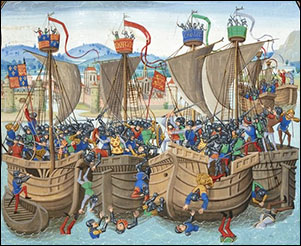
The Hundred Years' War was a ies of conflicts waged from 1337 to 1453 between the House of Plantagenet, rulers of the Kingdom of England, against the House of Valois for control of the Kingdom of France. Each side drew many allies into the war.
Through his mother, Isabella of France, Edward III was the grandson of Philip IV of France, and nephew of Charles IV of France, the last king with direct lineage to the House of Capet. In 1316, a principle was established denying women succession to the French throne. When Charles IV died in 1328, Isabella, unable to claim the French throne for herself, claimed it for her son. The French rejected the claim, maintaining that Isabella could not transmit a right which she did not possess. The French denial of Edward III's claim to the French throne initiated the period of conflict between England and France now known as the Hundred Years' War. Several overwhelming English victories in the war—especially at Crecy,Poitiers, and Agincourt—raised the prospects of an ultimate English triumph. However, the greater resources of the French monarchy precluded a complete conquest. Starting in 1429, decisive French victories at Patay, Formigny, and Castillonconcluded the war in favor of France, with England permanently losing most of its major possessions on the continent.
Historians commonly divide the war into three phases separated by truces: 1) the Edwardian Era War (1337–1360); 2) theCaroline War (1369–1389); and 3) the Lancastrian War (1415–1453). Contemporary conflicts in neighbouring areas, which were directly related to this conflict, included the War of the Breton Succession (1341–1364), the Castilian Civil War (1366–1369), the War of the Two Peters (1356–1375) in Aragon, and the 1383–85 Crisis in Portugal. Later historians invented the term "Hundred Years' War" as a periodization to encompass all of these events, thus constructing the longest military conflict in history.
 ser
ser
No hay comentarios:
Publicar un comentario